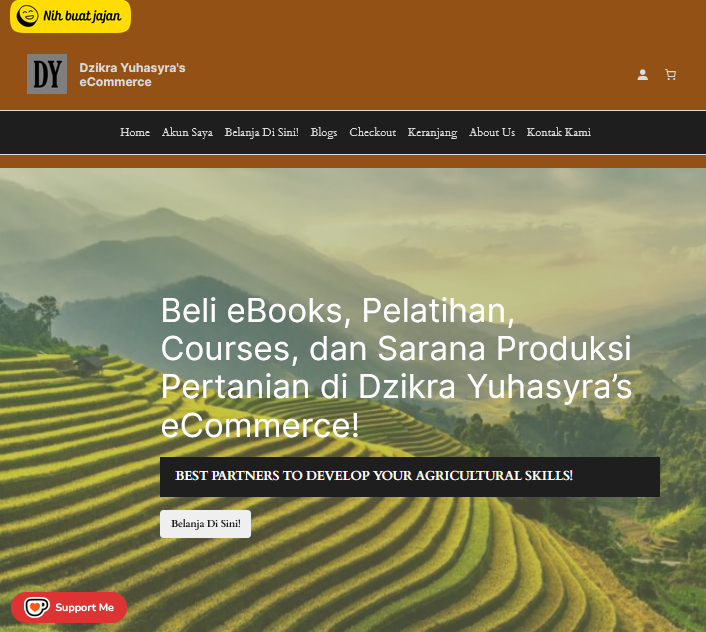
Here are Five Paragraphs of Short Explanation about Dzikra Yuhasyra’s eCommerce from Perplexity.ai. Enjoy!
“Dzikra Yuhasyra’s eCommerce is an innovative platform focused on enhancing agricultural skills through various educational resources. Founded in July 2024, it aims to provide e-books, training modules, and courses tailored for individuals interested in agriculture, from beginners to experts. This initiative reflects Dzikra’s commitment to supporting sustainable agricultural practices and empowering local farmers by offering valuable knowledge and tools for agricultural projects.
The platform is designed to cater to a diverse audience, including students in agricultural fields, hobbyists, and professionals. By collaborating with peers from his master’s program at Universitas Padjadjaran, Dzikra envisions creating a comprehensive resource hub that promotes agricultural development and best practices in Indonesia. This collaborative effort underscores the importance of community engagement in fostering growth within the agricultural sector.
Dzikra’s background in Agricultural Engineering and his ongoing master’s studies in Agricultural Economics equip him with the expertise needed to curate relevant content for the platform. His previous experience in sustainable living and media further enhances his ability to communicate complex agricultural concepts effectively. This foundation allows him to address various topics that resonate with the needs of his target audience.
As Dzikra Yuhasyra’s eCommerce continues to develop, it aims to become a leading platform in agricultural education. The website is currently in its launch phase, promising a user-friendly experience with reliable payment methods for seamless transactions. This strategic approach positions the platform as an essential resource for anyone looking to improve their agricultural skills or start new projects.
In summary, Dzikra Yuhasyra’s eCommerce represents a significant step towards advancing agricultural education in Indonesia. By providing accessible resources and fostering collaboration among stakeholders, it aims to empower individuals and communities to thrive in the agricultural sector. This initiative not only supports local farmers but also contributes to the broader goal of sustainable development within the industry.”
As I said on my previous Instagram posting, I will try to share materials that I learned on Entrepreneurship Development Banaras Hindu University Online Course. Now, I want to share about 15 Key Qualities of Entrepreneur, and I think it is important basic thing about how we as entrepreneurs should get the characteristics and ability that we must have. So, these are 15 Key Qualities of Entrepreneur and its short explaination. Enjoy!
1. Desire to Excel: Have “Never Give Up” Attitude
The entrepreneur should always engage in competitions with self imposed standards with himself to beat his last best performance.
2. Initiative: be Empathetic
Seeking personal responsibility for actions and use the available resources for optimisation of objectives.
3. Hard Work:
Possess an intense level of strong determination and willingness to work hard.
Capacity to work for long hours and in spurts of several days with less than normal amount of sleep.
4. Self-Confidence: Encourage and Uplift People
They have confidence and belief in themselves to achieve their desired objectives.
They do not believe in status quo, rather they believe that the events in their life are self-determined and have little belief in fate.
5. Moderate Risk-Taker: Learn from failures.
Successful entrepreneurs are neither high-risk takers nor gamblers.
They work in between the two extremes.
6. Motivation: Try to Cheer People Up
7. Innovative
An innovative entrepreneur introduces new products, develops new methods of production, discovers new markets, and reorganises the enterprise.
8. Optimistic: Have a lot of perseverance
Entrepreneurs do not believe that the success or failure of a new business venture depends mostly upon luck or fate or external uncontrollable factors.
9. Analytical Ability
They must be realistic in their approach.
They should not be affected by personal likes and dislikes.
In times of crisis, they must select experts rather than their friends and relatives to solve the problems.
10. Mental Ability: The inner strength of an entrepreneur.
It consists of the intelligence and creative thinking of an entrepreneur.
Through this ability, entrepreneurs are able to adjust themselves to the changing business environment.
They are never disturbed by any internal or external threat to their business or intermittent problems in accomplishing their goals.
11. Flexibility
If the situation demands a change in the decision that will be beneficial to the enterprise, then after analysing the pros and cons of the decision, the entrepreneur should revise or modify or change the decision.
12. Independence
They prefer to work in an environment free from interference.
13. Leadership
The entrepreneur must have an ability to lead so that he can induce the people to work with confidence and zeal.
It is an aid to authority and helps in better utilization of manpower.
They like to be independent in decision making of their own business.
14. Communication Ability
They must be well-versed in the art of communication.
In many situations to influence customers, employees, suppliers, creditors, and government and make them think in his way and act accordingly.
An entrepreneur who can effectively communicate and convince the above people will be more likely to succeed than an entrepreneur who does not.
15. Good Human Relations Ability
They must establish and maintain good relations with customers, employees, suppliers, financiers and other people related with the business to run it effectively and efficiently.
Emotional stability, tactfulness and warm human relations are some important qualities which bring success to an entrepreneur. An entrepreneur who maintains good human relations is much more likely to succeed in his business than the individual who does not practice such relations.
Conclusion:
• Entrepreneurship is the state of mind
• If you wish – you emerge as an entrepreneur
• Key Qualities which motivate an entrepreneur to capture Opportunities
As a child, your eyes sparkled with the majesty of your dazzling future.
You were connected to your power. You spoke only truths. Your heart was wide open.
The world was a safe place. Open for dreamers of every sort.
Welcoming to the possibilities that all of us represent.
Then something happened to most of us…
the doubts of those around us became our beliefs as well.
We embraced their limits. We adopted their fears.
This happened quietly, gradually and incrementally, so we couldn’t even see it happening to us. But our highest natures knew it: our boldness was diminishing. And our lights were dimming.
We started to settle. For average work. For minimum health. For scarcity of too many sorts. For a small amount of love in our lives.
And when we saw the ones who lived like lions. The Brave Few. We called them geniuses and gifted and otherworldly–denying the same potential hiding within ourselves.
But a day comes in every life when we can no longer run from the call for greatness that inhabits us. We must return to it. We have no choice.
For some, it’s leaving the safe harbor of an old way of being.
For some, it will be leaving a job to launch a dream.
For some, it will be finding new love.
And for a few of us, it will be battling the critics in the fight for a better world.
I don’t know you, your dreams or your desires….
…but I do know what you’re made of. Pure possibility. A core made of power. A mind made for visions. A heart built for love. A spirit designed to wow.
And so today, as you move through your hours, let go of who you were to become all you are. Please.
Return to greatness. Model mastery. Show us what the best of being human is all about. And lift us with your light.
Make this day epic. And let’s not take our tomorrows for granted.
One of the question that I try to dig is, “What is Happiness?”
People said that when we think about happiness, the actual condition is we are not happy, because someone who is really happy, don’t think about happiness. But not worry, we still should think the definition of ‘Happiness’ so we could have a state of mind and a solid guidance when people ask to us “What is Happiness”.
For me now, “the definition of ‘Happiness’ is a calm and peaceful mind that we fully live our present, not worry about the future or don’t feel regret about the past, but we feel enough to live the present, to live now, with a thankful heart for Allah’s blessings. The state of calm, peaceful, and thankful makes us feel glad, because the requirement of being happy is we must feel glad too, and the last condition about being happy is acceptance. We accept all of Qadha and Qadar from Allah SWT. We must believe and accept that our condition right now is the best result and condition from all of our effort and ikhtiar. That is the definition of ‘Happiness’ for me”.
It’s quite long, but I hope it could be something meaningful to you, all of my friends.
Dean Graziosi’s New Year Strategy Session, January 11, 23.00 Western Indonesian Time until January 12, 02.00 Western Indonesian Time.
Important Points from Dean:
1. Audit Your Inner Circle
We must be surrounding ourselves with constructive circles that make us grow and have the same lens to see the promising future
2. Solving Bigger Problems
We must try improve ourselves to solve bigger problems so we could make bigger impact and benefit for more people generally and of course ourselves specifically.
3. It’s on Me
We must independent and rely to ourselves first to solve our problems. We also must take responsibility to all of our actions and decisions. It’s on Me!
4. Who is Steering Your Ship?
We must steer our decisions for our future with our ownselves power not influenced by others interest or others thinking. It’s your life, steer your own-ship!
5. Selling is Service
When we sell something, make it as a service with the whole of benefit packages. We must serve our customers with the best service, not just let them give their money and we just go away.
6. Be Bold
Be bold in every actions and decisons we make. Be outstanding and give all your best!
7. Know Your Ideal Client
We must know our ideal client to make our products and services become the best solution for their problems. We must feel their conditions from A to Z and we comunicate to the them.
8. Focus on the Fix
We must focus on the fix things that it surely give maximize result to us.
9. Say “No” More
Say “no” to more things that are not giving beneficial thing or just giving waste time for us.
10. The Little Things are the Big Things
Every little things is a big things. Every our little steps, actions, words is a big thing that we should aware.
11. I Will Persist until I Succeed
Don’t stop until you got your success and goals! Be persistent.
12. Know Where Your Focus Should Go
Keep on track and stay focused! Focus on the matter thing that lead to our goals.
13. Work on Business You are Becoming
Do a business where make us near to the destination we are becoming.
14. Who vs How
Sometime we don’t just need to know how to do something, but we need to know with who we can do something more effective and efficient.
3 Types of Masterminds that we could make:
1. Collective Wisdom / Peers 2. Workshop – Front of Room Memberships 3. Monthly Group or Community
Triangle to Achieve Our Goals
We create levels from top of the triangle:
1. Make One Goal 2. Make Top Action 3. Decide What is Top Constraint 4. Decide What Kind of Capabilities, Persons, or Educations We Should Gain to Overcome the Constraint 5. Do Actions and Create a Specific Deadline to Measure and Make Sure We Gain the Capabilities, Persons, and Educations to Overcome the Constraints.
After we make the level of triangle, do it consistently from the bottom level to the upper level until we achieve our goal.
Another exercise we need to do from Nate Harris is we should write down the future successful version of ourselves that want to achieve in the next twelve months or next year. Because to solve our problems now just will be solved from successful version of ourselves in the future, not from someone else’s version.
Dalam buku “Memodernisasi Pertanian Indonesia” dari Center for Indonesian Policy Studies (CIPS) @cips_id terdapat Bab khusus yang membahas mengenai perlu beralihnya kebijakan subsidi pupuk dan benih dari pemerintah pusat/Kementan @kemenkopangan.ri@kementerianpertanian menjadi kebijakan yang lebih produktif dan efisien.
Dan salah satu rekomendasi kebijakan yang diusulkan yaitu mengganti kebijakan subsidi pupuk dan “beralih menjadi pembayaran langsung yang dilakukan melalui Kartu Tani”. Hal ini pula yang ingin saya teliti melalui Riset Tesis saya tentang Kebijakan Hibah Kartu Tani Sibedas di Kabupaten Bandung yang menerapkan mekanisme mirip seperti yang CIPS usulkan. Pada tesis yang sedang saya garap saya pun menekankan tentang Resiliensi Petani Padi melalui Pendekatan Penghidupan Berkelanjutan seperti yang dibahas pada buku ini di Bab sebelumnya.
Semoga hasil Riset Tesis saya kedepan bisa menjadi masukan yang berarti mengenai alternatif kebijakan dan intervensi pemerintah untuk meningkatkan kesejahteraan petani.
Hal lain yang juga saya soroti adalah harus digantinya indikator NTP (Nilai Tukar Petani) menjadi Indeks Kesejahteraan Petani yang lebih kompleks dan menyeluruh agar kebijakan pemerintah tidak terjebak pada indikator yang kurang merepresentasikan kondisi dan kebutuhan riil petani di lapangan.
Shane Hamilton’s “Supermarket USA: Food and Power in the Cold War Farms Race” explores the intricate relationship between American supermarkets, agricultural policies, and Cold War dynamics. In the Introduction, Hamilton posits that supermarkets served as symbols of capitalist abundance, showcasing the superiority of American economic systems over socialist counterparts. He introduces the concept of the “Cold War Farms Race,” emphasizing that agricultural productivity became a critical battleground in the ideological conflict between capitalism and communism. The author argues that while supermarkets were perceived as embodiments of free enterprise, they were fundamentally supported by significant state investment in agricultural technology and infrastructure.
Chapter 1, titled “Machines for Selling,” focuses on the Great Atlantic & Pacific Tea Company (A&P), which was a dominant force in the supermarket industry during the mid-20th century. Hamilton illustrates how A&P’s distribution system exemplified American abundance, contrasting it with the scarcity experienced in socialist countries. The chapter highlights A&P’s operational strategies and their implications for consumer access to food, reinforcing the political messages associated with capitalist success. In Chapter 2, “The Farms Race Begins,” he examines the rise of industrial agriculture in the U.S., detailing how government policies and technological advancements facilitated this growth, thereby supporting supermarket expansion and countering communist ideologies.
The subsequent chapters delve into the global implications of American supermarkets. Chapter 3, “Supermercado USA,” discusses how U.S. supermarket models were exported as tools of economic influence in foreign markets, while Chapter 4 contrasts American supermarkets with socialist grocery systems, highlighting ideological battles over consumerism. Chapter 5, “Food Chains and Free Enterprise,” explores the complex relationships within food supply chains, revealing how supermarkets shaped agricultural practices and rural economies. Finally, Chapter 6, “Food Power and the Global Supermarket,” addresses how American supermarkets became instruments of U.S. foreign policy, promoting not just economic interests but also cultural values associated with capitalism. The Epilogue reflects on the lasting legacy of supermarkets as powerful symbols of economic power and consumer culture that shaped international food systems during and after the Cold War.
Recommend to read!
After I read “Supermarket USA” Book by Shane Hamilton, I am thinking about transformational change in American Agriculture from we call “traditional agriculture” to become “Agribusiness”. In the mid 60s, America had surplus in main commodity because of the advancement of agricultural technology.
The idea to absorb the surplus in the farmer’s harvest was between regulate by the government or let the supply and demand did it’s part with Free Enterprise and Private Sector role. The option that chosen was the free enterprise and private sector took the role to let the supply and demand played it’s magic, and from here “Supermarket” took a big part as a tool and propaganda of abundance of food for all of Americans and the world against the Communism.
The “Supermarket” created the term of “Consumer Sovereignty” that gave the consumer goods and products in affordable price and many options of it. The journey was continued to make the supply chain and market price efficient and effective with created bigger and merged retail chain, so merging of small retailer and aggregator was something a must on that period. It created the oligopsony and oligopoly retail chain until now, and it expanded to global market also other countries followed the steps.
Today, the supermarket, like Walmart and Amazon, is the leading enterprise in the world with the most sophisticated technology and system. But the critics say, it make our food should come from far away from our location create the term “food from nowhere”. So the latest movement is appeared to counter the issues, like Community Supported Agriculture (CSA), short food supply chain, city gardening, local community of agricultural products, even gardening in front of our yard.
Let’s see and make a research how to create the most sustainable way of our food system.. I hope I can get the answer immediately.. InsyaAllah..
Website Dzikra Yuhasyra’s eCommerce bersiap untuk launching dan dalam tahap pengembangan!
Saya, Dzikra Yuhasyra, Alumni Program Studi Rekayasa Pertanian SITH ITB angkatan 2013 yang sekarang sedang menempuh pendidikan di jenjang Magister di Program Studi Magister Ekonomi Pertanian Faperta UNPAD angkatan 2023 ganjil dan berdomisili di Kota Bandung, Jawa Barat, baru saja membuat dan mengembangkan website e-Commerce yang khusus dibuat untuk meningkatkan agricultural skill dan menyiapkan pelaksanaan agricultural project baik untuk masyarakat umum, pemula dan penghobi di bidang pertanian, mahasiswa di jurusan pertanian dan bidang terkait, sampai praktisi dan expert di bidang pertanian.
Saya menginisiasi website ini bersama rekan sejawat di Magister Ekonomi Pertanian Faperta UNPAD, yaitu Kang Suryadi Abdul Gani dan Kang Agum Restu Alam. Kami mempunyai visi besar ke depan untuk menjadi leading platform dalam berbagai aspek di bidang pertanian, mulai dari penyediaan skill dan pengetahuan, seperti e-Books, modul, pelatihan, courses, training, sampai penyediaan berbagai persiapan, sarana produksi, teknologi pertanian, dan keperluan lainnya untuk memulai suatu proyek pertanian, mulai dari skala kecil sampai skala besar. Semoga visi besar ini dapat terlaksana ya! Aamiin..
Dzikra Yuhasyra’s eCommerce bisa dikunjungi di link:
Jangan lupa beli e-Books, Courses, Pelatihan, dan Sarana Produksi Pertanian di Dzikra Yuhasyra’s eCommerce untuk meningkatkan agricultural skill dan memulai agricultural project-mu!
Dzikra Yuhasyra’s eCommerce: Best Partners to Develop Your Agricultural Skills!
Mari majukan Petani, Generasi Muda Tani, dan Pertanian Indonesia!
Mengapa ‘policy’ dimaknai sebagai ‘kebijakan’ dalam Bahasa Indonesia?
Menteri Luar Negeri Retno LP Marsudi berpidato pada pembukaan forum Kebijakan Luar Negeri dan Kesehatan Global di Kantor Kementerian Luar Negeri, Jakarta, pada Januari 2020. M Risyal Hidayat/Antara Foto
Lewat lema ‘kebijakan’, bahasa Indonesia menyamakan ‘policy’ dengan kebijaksanaan.
Padahal, kalau kita bandingkan dengan bahasa lain, makna ‘policy’ lekat dengan ‘politics’ (politik).
Misalnya, ‘policy’ dalam bahasa Melayu adalah ‘polisi’, dalam bahasa Belanda ‘politiek’, bahasa Prancis ‘politique’, dan dalam bahasa Arab ‘siyasah’. Bahkan, kata ‘policy’ tidak berbeda secara makna dengan kata ‘politik’ dalam bahasa Denmark ‘politik’ dan bahasa Italia ‘politica’.
Sangat berbeda dengan yang terjadi dalam bahasa nasional kita. Saya mencari tahu mengapa kata ini dipilih lewat riset linguistik sejarah semantik kata ‘kebijakan’.
Kebijakan dan makna terkait
Kata ‘kebijakan’ merupakan kata benda dari akar kata ‘bijak’. Imbuhan ke- dan -an berfungsi untuk membuat kata benda dari bijak yang menggambarkan kondisi yang berhubungan dengan akar kata tersebut.
Kamus Besar Bahasa Indonesia (KBBI) menghubungkan kata sifat ‘bijak’ dengan dua makna, yaitu selalu menggunakan akal budinya; pandai; mahir; dan pandai bercakap-cakap; petah lidah.
KBBI lalu mendefinisikan kata kebijakan sebagai dua hal. Yang pertama kepandaian, kemahiran, dan kebijaksanaan. Dan yang kedua rangkaian konsep dan asas yang menjadi garis besar dan dasar rencana dalam pelaksanaan suatu pekerjaan, kepemimpinan, dan cara bertindak (tentang pemerintahan, organisasi, dan sebagainya); pernyataan cita-cita, tujuan, prinsip, atau maksud sebagai garis pedoman untuk manajemen dalam usaha mencapai sasaran; dan garis haluan.
Konstruksi kata ‘kebijakan’ ini bisa dikaitkan dengan ‘kebijaksanaan’, yang merupakan kata benda dari ‘bijaksana’. Kata ‘bijak’ dan ‘bijaksana’ memiliki makna yang sama.
Namun, kebijaksanaan lebih universal daripada kebijakan. Kebijakan memiliki asosiasi spesifik yang merujuk pada ‘policy’, dan muncul pada wacana politis.
Kata lain yang anagram dan homofon dengan kebijakan adalah kebajikan. Akar kata ‘bajik’ berarti baik, sehingga kebajikan berarti sesuatu yang mendatangkan kebaikan (keselamatan, keberuntungan, dan sebagainya) dan perbuatan baik.
Meski ‘kebajikan’ tidak digunakan dalam konteks politik, anagram dan homofon ini berpotensi menciptakan bayangan makna sehingga kebijakan bisa diasosiasikan dengan kebajikan dan kebijaksanaan.
Bayangan makna ini bisa meletakkan ‘kebijakan’ pada posisi baik yang universal dan tidak bermakna politis (apolitis).
Dengan demikian, ‘kebijakan’ menjadi tidak dapat ditentang, karena siapa yang bisa melawan kebijaksanaan atau kebaikan?
Kemunculan kata kebijakan
Tidak mudah untuk menelusuri awal mula kemunculan sebuah kata. Ada dua sumber yang bisa digunakan, yakni kamus dan penggunaan sehari-hari yang terdokumentasi.
Dalam perkembangannya, bahasa Indonesia dipengaruhi oleh Bahasa Melayu, Bahasa Jawa, Bahasa Belanda, Bahasa Arab, dan bahasa asing lainnya termasuk Bahasa Inggris. Saya melakukan studi bahasa pada kamus monobahasa maupun dwibahasa dalam bahasa di atas yang diterbitkan dari tahun 1901, 1916, 1920, 1953, 1970, 1982, 1988, 2004 hingga kamus digital tahun ini.
Pada awal 1900, kata ‘kebijakan’ tidak ada dalam kamus Bahasa Melayu, tapi ada kata ‘bijak’. Dalam kamus tersebut, ‘policy’ diterjemahkan menjadi peraturan. Kamus Bahasa Jawa 1920 mencatat kata ‘wicaksana’, yang kemudian diadopsi menjadi bijaksana dalam bahasa Indonesia.
Pada Abad ke-15 dan ke-16, ‘policy’ juga disebut sebagai political sagacity dalam bahasa Inggris, yang artinya kecerdasan politis.
Istilah ‘politics’ dan ‘political strategies’ muncul beberapa abad setelah itu. Istilah ini muncul dalam pidato Presiden Sukarno setelah Indonesia merdeka untuk mengkritik imperialisme.
Pada masa pemerintahan Sukarno (1945–1966), kata ‘kebijaksanaan’ sangat jarang ditemui di dokumen kenegaraan. Setelah mencermati dokumen kebijakan yang sudah didigitalisasi, kata ‘kebijaksanaan’ muncul dua kali di Ketetapan Majelis Permusyawaratan Rakyat Sementara (TAP MPRS) No. II/MPRS/1960.
Kata ‘amanat’ dan ‘manifesto’ lebih sering digunakan pada masa Orde Lama, misalnya amanat presiden dan manifesto politik. Kata ‘amanat’ merupakan transliterasi dari bahasa Arab yang berarti tanggung jawab kepada Tuhan. Sedangkan ‘manifesto’ adalah kata yang sudah dihapus selama masa standardisasi dan netralisasi bahasa Indonesia pada zaman Orde Baru.
Pada masa Orde Baru, kata kebijaksanaan dan kebijakan lebih sering muncul untuk merujuk makna ‘policy’.
Meski ‘policy’ konsisten diterjemahkan sebagai ‘kebijakan’, ada dua pengecualian, yakni pada “Politik Etis” dan “Politik Luar Negeri”.
Politik Etis merupakan terjemahan dari bahasa Belanda ‘Ethische Politiek’ yang seharusnya – jika ingin konsisten – diterjemahkan menjadi Kebijakan Etis.
Begitu pula halnya dengan Politik Luar Negeri adalah terjemahan dari Foreign Policy.
Ini semakin menegaskan bahwa penerjemahan kata ‘policy’ tidak pernah netral.
Membongkar ‘kebijakan’
‘Kebijakan’ pada dasarnya memiliki sifat apolitis, tapi ‘policy’ jelas-jelas melibatkan proses politik; menempelkan kedua kata ini menjadi tidak masuk akal.
Atau mungkinkah pemilihan kata ‘kebijakan’ menjadi tabir untuk menutupi proses politis yang terjadi?
Standardisasi bahasa yang ketat dilakukan tidak semata-mata untuk estetika kebahasaan, tapi untuk alat kepentingan kekuasaan. Bahasa bukanlah kacamata netral untuk mengenali realitas, tapi alat untuk mengkonstruksi realitas.
Seiring dengan perkembangan Indonesia yang semakin demokratis, banyak pihak mempertanyakan kebijakan yang tidak bijak. Kata ‘kebijakan’ perlu kita tinjau kembali untuk memisahkan makna kebijaksanaan dan kebajikan dari ‘policy’.


%20%E2%80%93.jpg)